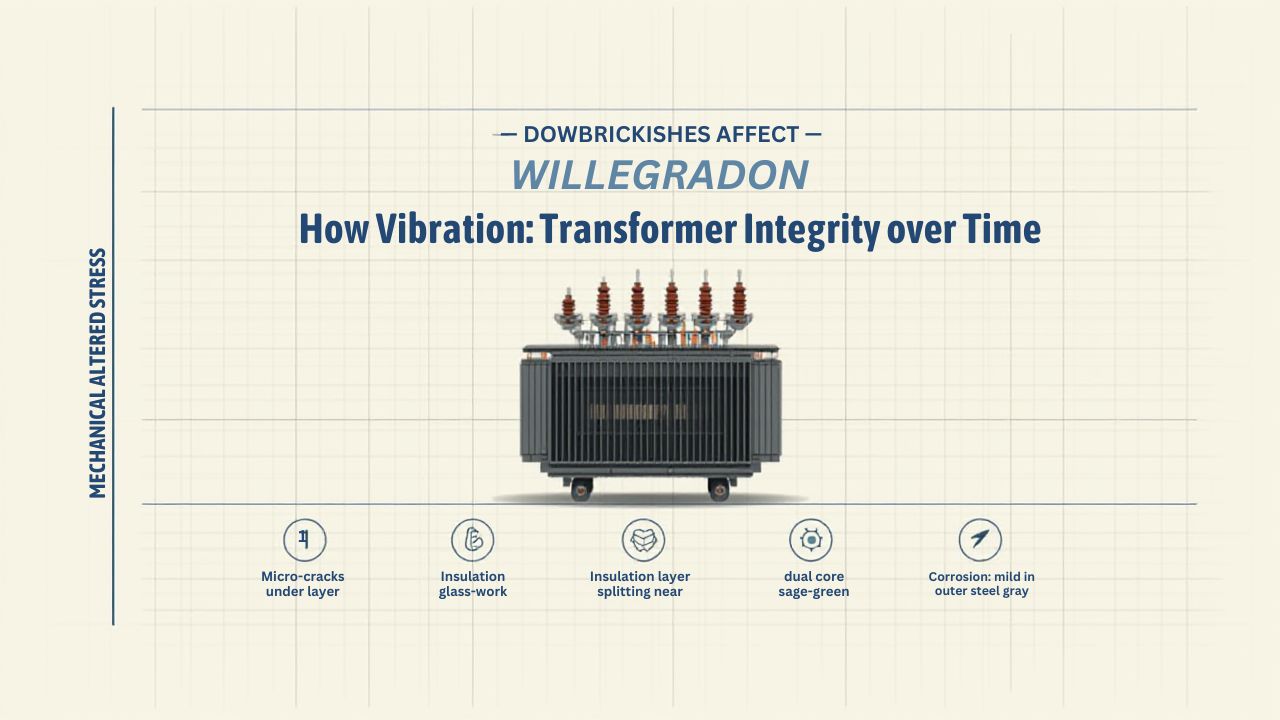
A transformer can keep running for years while its internal condition slowly changes. Vibration plays a big role in that shift. You hear a hum, you feel a mild tremor on the tank, and it all seems familiar.
The problem starts when repeated movement begins changing how tightly parts stay seated inside the unit.
Here is where that wear usually begins and why it matters later.
The core depends on stable clamping to keep the lamination stack tight and the magnetic path consistent. Vibration works against that stability little by little. Pressure starts changing across the stack, especially around bolts, yoke areas, and insulation pads that have already seen long heat cycles.
Once the pressure stops staying even, the core no longer behaves the same way from end to end. Local losses rise, noise characteristics shift, and specific areas begin carrying more mechanical stress than they were meant to.
Windings sit inside a support system made to hold position under load, thermal expansion, and short-circuit force. Vibration changes how that support system behaves over time. Spacers compress differently, blocks settle, and the pressure around the winding becomes less balanced.
Even slight movement matters because winding geometry depends on precision. A coil does not need to move far to change insulation pressure or conductor spacing.
Once that internal balance starts drifting, the winding becomes more vulnerable during future load swings or fault events.
Electrical joints live at the point where mechanical wear turns into heating. Vibration affects flexible leads, clamp faces, terminal hardware, and connector surfaces. As these parts keep moving through tiny repeated cycles, contact pressure can fall just enough to change how current passes through the joint.
Resistance rises at one location, heat builds there, and the surrounding insulation starts carrying that extra thermal stress.
In many service cases, a transformer comes in with a temperature complaint that traces back to a connection that had been slowly losing contact quality for a long time.
The tank, radiators, pipe joints, and external hardware often reveal what the internal structure has been dealing with.
A fitting that needs repeated tightening, a gasket line that starts showing a slight oil trace, or a radiator support that vibrates more than it used to can all point back to long-term mechanical activity inside the transformer.
These signs look minor when viewed one by one. Seen together, they often show that vibration has been traveling through the structure and redistributing stress across the unit.
Large industrial transformers, especially those used in furnace duty, experience stronger electromechanical forces and sharper operating cycles than standard service units. Under those conditions, vibration stops being a background condition and becomes part of the transformer’s aging pattern.
Each cycle adds movement, each movement changes pressure, and each pressure change affects heat, alignment, or contact quality somewhere else in the system.
This is one reason vibration-related wear often shows up earlier in rebuild work on high-duty units than it does in lighter applications.
Vibration rarely enters the workshop as the stated fault. More often, it shows up through the damage it has left behind in clamping systems, winding supports, lead joints, and fittings.
In our inspection, overhaul, and rebuild work, these patterns appear regularly once the transformer is opened and the internal structure becomes visible.
A unit may still be carrying load well while its mechanical margin has already narrowed.
Catching those signs early gives you more room to plan service before the wear turns into heat, leakage, or a deeper internal repair.
To learn more, get in touch with us today.