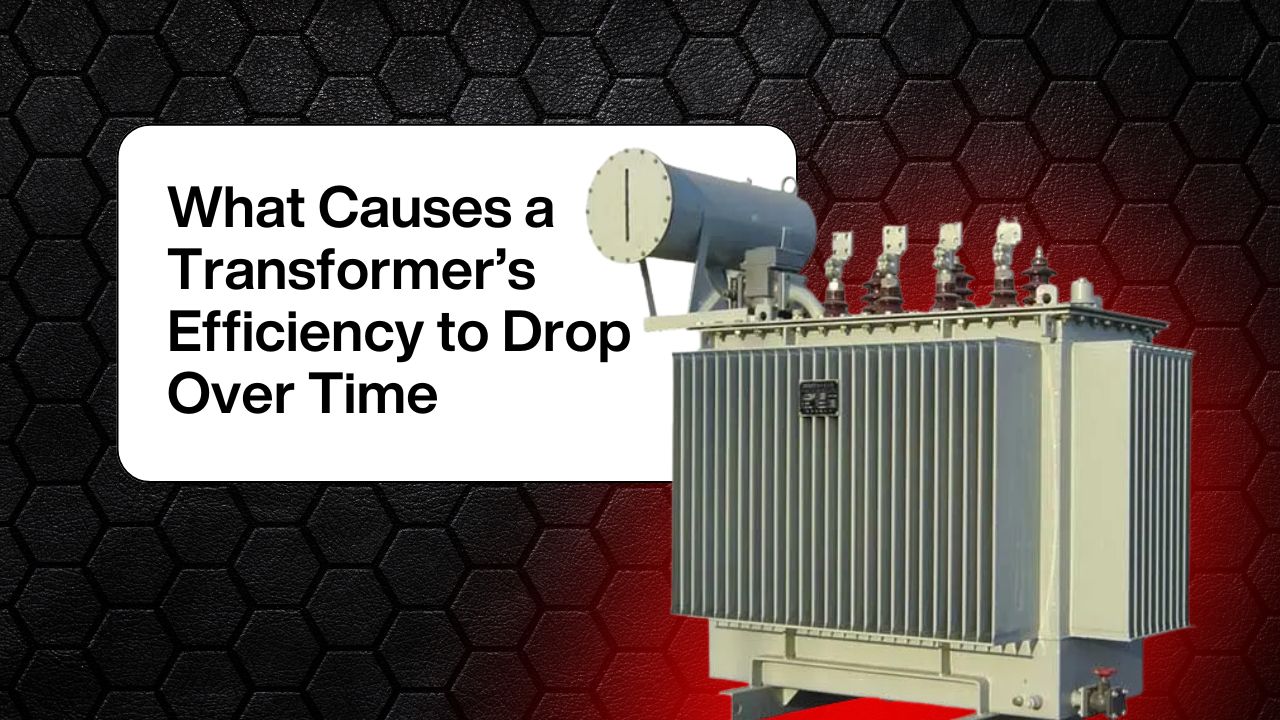
Not every efficiency drop shows up on a meter. You usually sense it first in small shifts (more load for the same output, longer cooling cycles, subtle temperature hikes).
These shifts often go unnoticed until energy costs start rising or system capacity feels tighter than before. That’s when the conversation around refurbishing or replacing the unit begins.
Here’s what usually drives the decline behind the scenes.
The first culprit is often the winding itself.
Over time, the layer insulation around conductors wears down. Microscopic cracks or moisture seepage allow partial discharges to creep across surfaces, even when the voltage stays within rated levels.
These events do not trip alarms, but they gradually roughen the current path. More resistance means more heat. And that heat takes a quiet toll, turning efficient turns into sluggish ones, cycle after cycle.
The core does not need to break to become inefficient. What usually happens is that internal stress builds up from repeated heating and cooling. Lamination joints may begin to open slightly, or pressure inside the yoke changes with age.
This affects how flux travels through the core. It may require a higher excitation current to achieve the same power. Or you might notice higher idle losses with no clear fault. These signals often point back to a core that’s no longer in sync with itself.
Oil condition matters far beyond the fill level. As oxygen, water vapor, and heat interact with the oil over time, the chemical makeup changes.
Sludge may begin to form. Acidity levels climb. Dielectric strength drops.
These changes not only affect insulation but also heat transfer. Even with the fans and radiators running perfectly, aged oil moves heat less efficiently.
The result is a warmer tank, slower cooling, and a cycle that strains both insulation and metal.
Efficiency losses also trace back to connections. Bushings, clamps, and links—each plays a role in passing current cleanly.
Over time, joints loosen, oxidation forms, or pressure weakens at contact points. One infrared scan during steady load often reveals these losses long before a wrench or meter confirms them.
The resistance increase here does not always trigger a temperature alarm, but it shows up in the data. Slight voltage drops. Irregular current readings. Contact losses rarely act alone, but they often amplify the effects of core and coil ageing already underway.
Transformer efficiency never drops in a straight line. It bends around load history, installation quality, and how well each component holds up under pressure.
In our experience working with both industrial and utility setups, these signs usually unfold gradually, but accelerate once they start. That’s why we design refurbishments not as one-off fixes but as layered recalibrations (coil, oil, core, and contacts aligned again for real performance).
If you’re deciding whether to upgrade, rebuild, or rotate a unit back in, we’re always open to walking you through how we approach that decision for our clients. Get in touch with us and let’s talk.