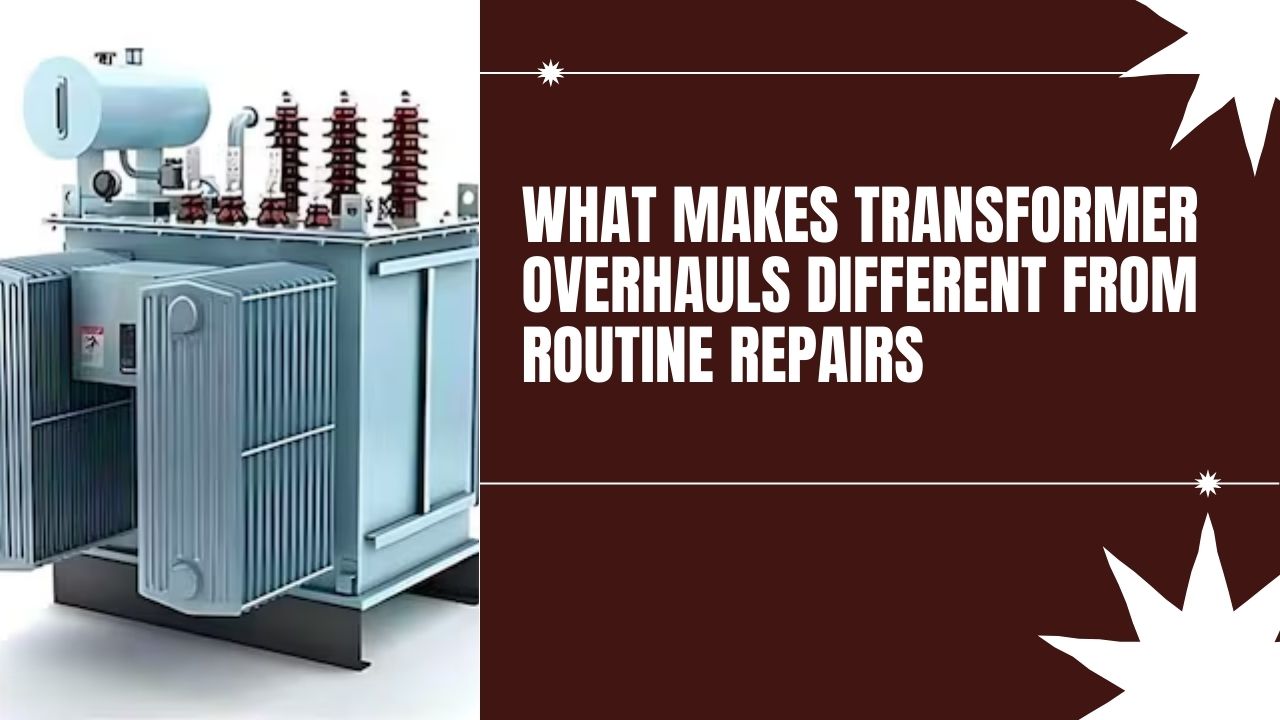
A quick repair can help restore output, but it rarely shows the full picture. If the issue keeps returning (or if several faults are stacking up), your unit might be showing deeper signs of fatigue.
One failed bushing or terminal crack may trace back to stress built up across insulation, clamping, or core alignment. These are not surface-level faults, and they often require something more complete.
Here’s how a full transformer overhaul differs from a standard service run.
Standard repairs usually focus on the specific point of failure. Overhauls start with the opposite mindset. The unit is opened fully and stripped down to its structural elements. That includes removing core clamping structures, lifting coil stacks, and logging their alignment before moving anything.
This mapping creates a reference baseline, so technicians can spot geometric distortions, coil lean, or insulation swelling before reassembly begins. Without that kind of teardown, mechanical wear can stay hidden behind a clean enclosure.
Post-repair tests are usually confined to turns ratio, winding resistance, or insulation resistance. Overhaul tests go deeper. Surge comparison reveals winding movement. SFRA (Sweep Frequency Response Analysis) detects core displacement.
Oil quality checks are paired with DGA trends from before teardown to see what changed and why. This layered testing helps confirm that the overhaul didn’t just patch the unit; it realigned it.
Overhaul teams trace through the build from the inside out. They inspect each winding interface, each layer of insulation, and each pressboard barrier.
What they’re often looking for is not just burn marks or hot spots, but small fractures, compression fatigue, or signs of shifting caused by through-faults or harmonic vibration.
Even minor clamp relaxation can trigger resonance under load. Sequencing each inspection helps teams confirm whether stress is isolated or systemic. That nuance is hard to gather with repairs alone.
Magnetic aging can occur when mechanical stress warps the lamination stack. The flux path distorts, and eddy losses begin to rise.
Core tightening in an overhaul is about more than torque; it’s about regaining symmetry and minimizing uneven induction.
Makpower’s teams often use laser alignment and torque-stage reassembly to bring back balance in the core window. Without these steps, units may resume operation but draw more magnetizing current than they should.
A transformer overhaul moves past reactive work. It rewinds stress, resets geometry, and restores thermal and magnetic balance.
It’s a process Makpower uses selectively, often on units that have served beyond their rated window but still show structural promise.
When done right, an overhaul can add fresh life without the cost of full replacement. If you're weighing options between a swap and a refurb, our reconditioning service helps you make that call with full visibility.