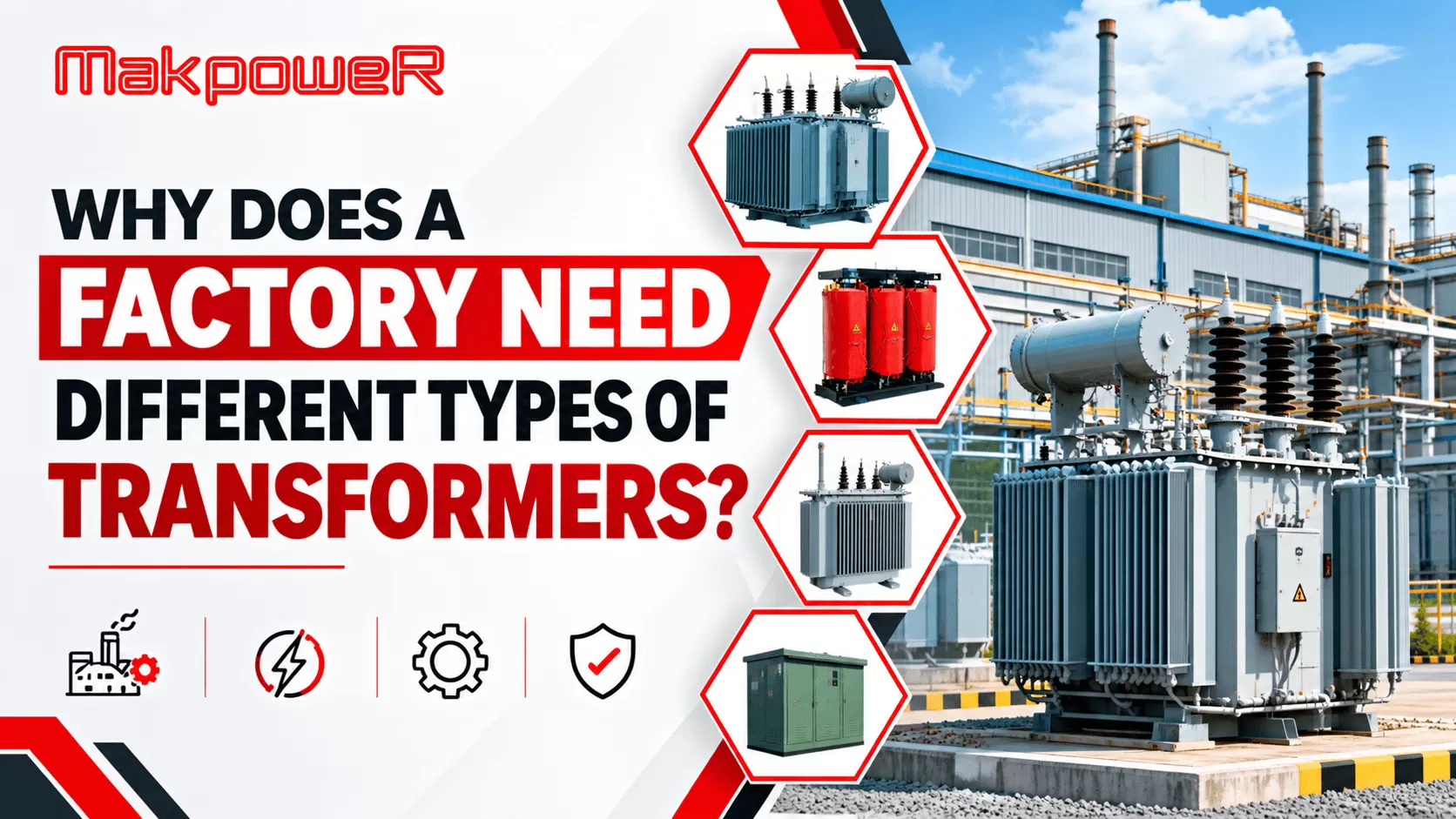
A large factory rarely relies on one transformer to handle every electrical job. Power may enter the site at one voltage, move through the plant at another, and reach specialised production equipment under completely different operating conditions.
A transformer feeding pumps and ventilation has a relatively steady job. A transformer serving a melting furnace may face heavy current, rapid load changes, and repeated production cycles.
The easiest way to understand the difference is to follow electricity from the incoming supply to the equipment using it.
Utility power can reach an industrial facility at a voltage that needs to be reduced before it enters the plant distribution system. A power transformer handles this first major step and supplies the electrical network from which other parts of the factory receive power.
Its design follows the total plant demand, incoming and outgoing voltage, expected loading, and cooling requirement. A large manufacturing site running several production areas will naturally place a different demand on this transformer than a smaller facility with fewer major loads.
This unit therefore deals with the factory at a broad electrical level rather than with the needs of one individual machine or process.
General plant equipment usually needs electricity at practical distribution voltages suited to motors, pumps, ventilation, workshops, cooling equipment, lighting, and control systems.
Distribution transformers and auxiliary transformers can serve these loads without tying every part of the facility directly to the main incoming transformer.
Consider a transformer supplying workshop motors and cooling pumps. Its daily load may remain fairly predictable compared with the transformer feeding the melting shop a few buildings away.
Keeping these duties separate also lets the transformer selection reflect the equipment actually connected to each part of the plant.
Some manufacturing processes create electrical demands that call for a transformer designed specifically around the equipment being supplied. Melting and power-conversion applications are good examples because the transformer becomes closely tied to the behaviour of the production process.
> Arc furnace transformers supply furnaces that require very high secondary current and operate through demanding melting cycles where the electrical load can change sharply.
> Induction melting furnace transformers work with induction furnace systems and are selected around the electrical arrangement, production duty, and load behaviour of the melting equipment.
> Rectifier or converter-duty transformers supply systems where electrical power passes through converters or rectifiers before reaching the industrial process, creating requirements different from ordinary plant distribution.
The transformer beside the production equipment is therefore chosen around the process itself, rather than simply around the factory’s overall power demand.
A factory rarely keeps the same electrical arrangement throughout its entire life. A new production line, larger furnace, additional motor group, or change in operating hours can create a load that deserves its own transformer rather than being added to an existing unit.
On-site generation introduces another requirement. Where a factory generates electricity, a generator transformer may form part of the connection between the generating equipment and the electrical system receiving that power.
This is also why discussions with a transformer supplier in India often need to begin with the application rather than a rating alone. Voltage, load pattern, process behaviour, cooling arrangement, available space, and future expansion all influence the selection.
For the same reason, a transformer manufacturer in Kolkata serving industrial plants may manufacture several transformer types even though every unit is based on the same basic principle of transferring electrical power.
Walk through a factory from the incoming substation to the production floor and the need for different transformers becomes fairly easy to see. The electrical job changes along the way, so the transformer serving each part of the plant has to match the voltage, load behaviour, and equipment connected to it.
Makpower Transformer manufactures power, distribution, auxiliary, generator, arc furnace, induction melting furnace, and converter-duty transformers for industrial applications.
Our team works from the intended application and operating duty when discussing a transformer requirement, because choosing the right type starts with understanding the job the unit will perform inside your facility. To learn more, get in touch with us today.
Specialized in Induction Furnace Transformers, Step-Voltage Regulators, and 25 MVA 132kV Substation Class Power Units.
Contact Technical Team