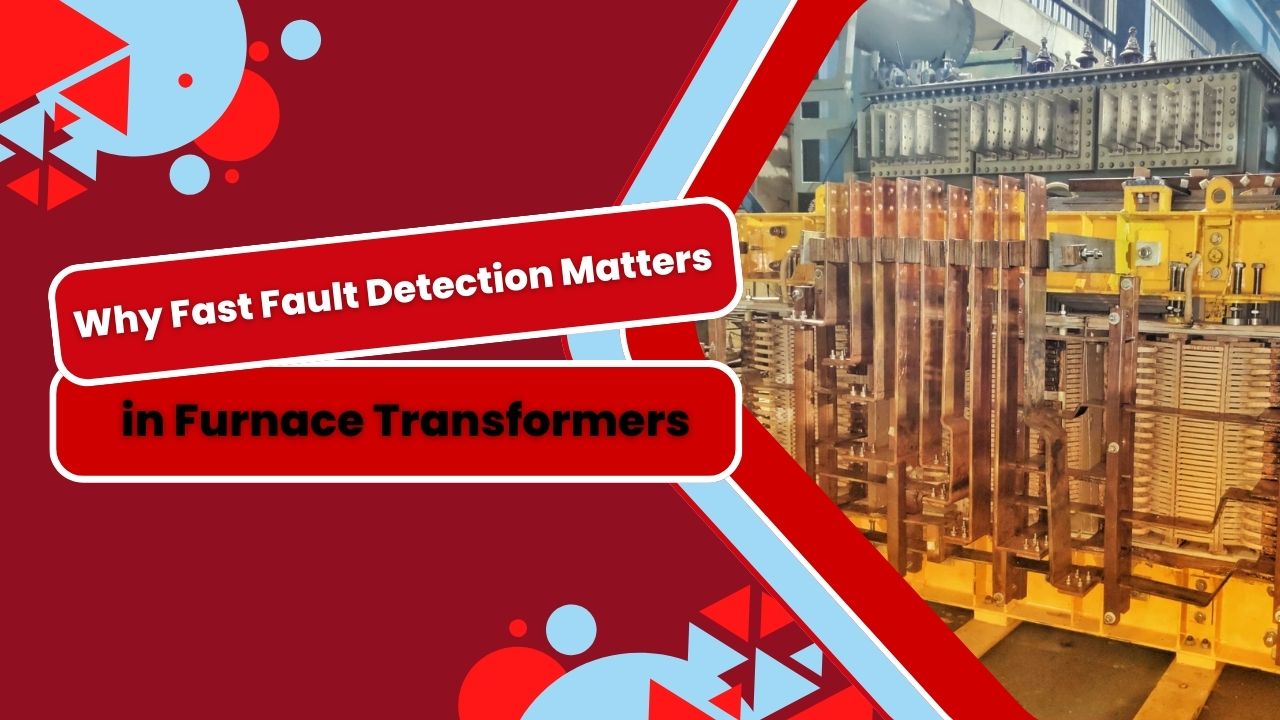
Furnace transformers work in one of the most unpredictable environments. Loads swing sharply. Faults can spark within milliseconds. You rarely get a second warning.
Teams that work with these units already know this. One moment the current peaks, the next, the system is silent. And what follows often affects more than the transformer itself.
Here’s how faster fault detection changes that outcome.
Furnace transformers carry heavy, often erratic loads. When arcs strike or material shifts, the electrical stress spikes. Each second under fault pressure accelerates the risk to windings and insulation.
You may never see visible damage at first, but internal hotspots start forming almost instantly. In these conditions, the time between “slight anomaly” and “catastrophic failure” can shrink fast.
This is why fast trip action plays a key role not just in protecting the load, but in preserving the core integrity of the transformer.
Faults that go undetected or untripped don’t always destroy a system at once. But they start shaving life off it.
Partial discharge, heating around weak spots, and repeated stress on the same insulation paths all add up.
This wear shows up months later as uneven ageing, unexplained oil breakdowns, or sudden deformations in coil shape.
A strong protection system catches faults early and clears the circuit before this slow damage creeps in. Without that, the transformer ages unevenly and becomes harder to service predictably.
After a fault, even a moment of hesitation in tripping or isolating the issue disturbs the load pattern. In furnace operations, this instability shows up as:
Each of these affects not just the transformer, but the entire chain of operations around it.
Rapid detection tools help isolate the event early and preserve load continuity in the rest of the system.
A well-configured relay system responds fast enough to prevent thermal runaway. It does more than just trip; it responds in a way that aligns with the transformer’s real application.
If trip logic is tuned too broadly, you risk late action. Too sensitive, and you interrupt operations unnecessarily.
Getting this balance right starts with knowing how fast the windings need protection during typical arc faults.
Some Makpower transformers include adaptive relay systems that use field conditions to improve response time tuning over their service life.
You can design a transformer to handle short-circuit stress. But if the fault detection lags (even for half a second), that margin gets used up fast.
In furnace contexts, detection speed becomes a design partner, not a backup.
Teams that treat it this way often see longer intervals between rewinds, fewer unplanned shutdowns, and more accurate post-fault diagnostics. Design and protection have to work together in real time, not just on paper.
This coordination starts at the relay level but extends to sensing thresholds, breaker selection, and even grounding strategy. Fast-acting systems also help preserve insulation life, as they reduce the thermal and mechanical strain that builds up during those critical early milliseconds of a fault.
Furnace units demand more from their protection schemes than standard systems do. Faults escalate faster, loads swing harder, and the consequences spread beyond just one transformer.
Our teams build and deploy furnace-ready systems that respond to these conditions, whether it’s in steel melting, induction heating, or field repair.
When you tune fault response to match real use, you extend both the transformer’s life and the system’s resilience. If you're seeing protection delays during fault events, we can help you evaluate what might be missing. Get in touch with us and let’s talk.