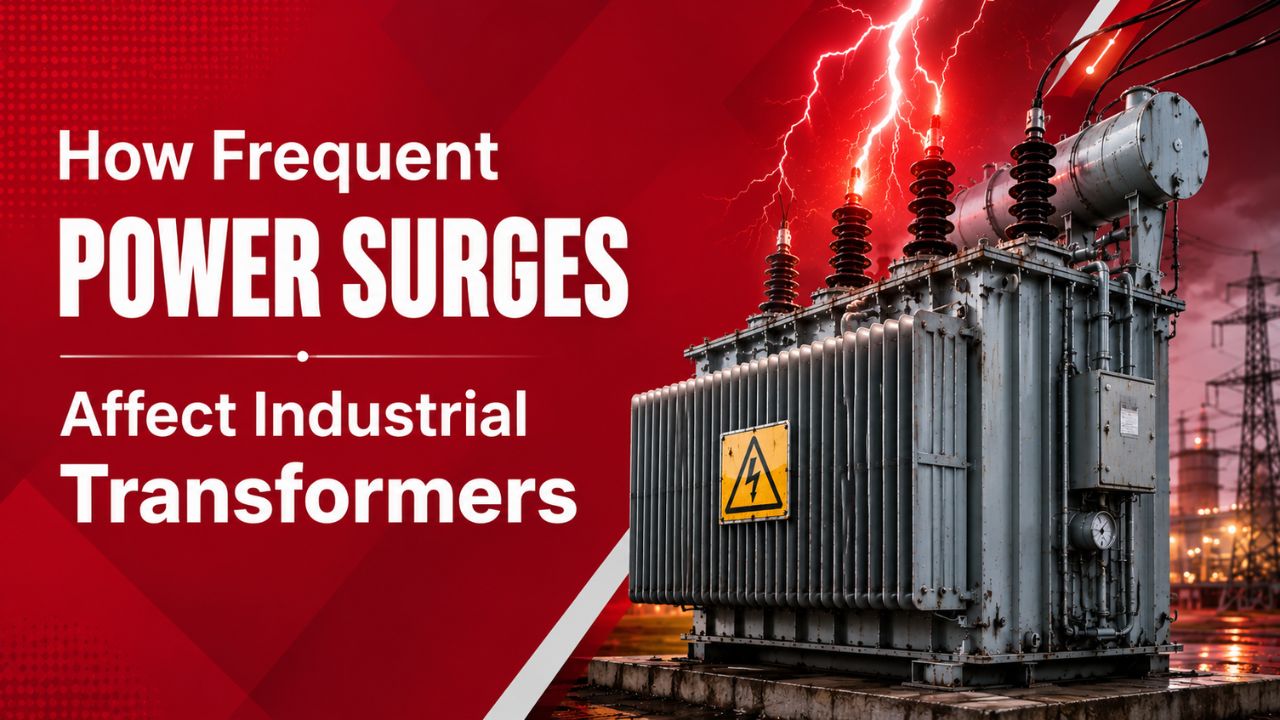
A transformer can ride through one sharp voltage event and keep working without much drama.
The problem grows when those events keep returning. In an industrial plant, surges can come from switching, feeder disturbances, lightning exposure, or the way large equipment enters and leaves service around Industrial Transformers.
Each surge lasts only a moment, yet the stress it creates can stay behind.
Here is how repeated surges begin changing transformer performance.
The first part to feel repeated surge stress is usually the insulation system.
A fast overvoltage pushes sharp electrical stress across winding insulation, bushings, and internal clearances. One event may pass without leaving an obvious sign, yet repeated exposure can slowly reduce dielectric strength and narrow the electrical margin inside the transformer.
The unit may still run normally from the outside. Inside, the insulation is carrying more history than before.
One surge and a hundred surges do not leave the same condition behind.
A single event may come and go quietly. Repeated surges create cumulative strain because the transformer keeps absorbing brief electrical shocks across the same internal paths. As Makpower often highlights in the performance assessment of Industrial Transformers, over time, turn-to-turn stress, insulation fatigue, and local weak points stop starting from a fresh condition.
This is where the risk changes. The transformer may still carry load, though with less tolerance for the next event.
Industrial plants often create a tougher electrical environment than a simple supply line would suggest.
Large motors, switching operations, uneven restart patterns, and fast load changes can all contribute to overvoltage stress moving through the network. A transformer in this setting may face more frequent electrical shocks than its load profile alone would suggest.
That is why surge exposure in plants often needs to be understood as part of the operating environment, not as a rare outside event.
Surge-related wear usually shows up indirectly.
You may notice a bushing area that stays harder to keep clean, a protection response that feels more sensitive than it used to, or a transformer that sounds rougher during certain switching conditions. In some cases, local tracking, insulation stress, or changed thermal behavior becomes the earlier clue.
Seen one at a time, these signs can look unrelated. Seen together, they often point back to repeated voltage stress.
Protective devices make a real difference in how much surge stress reaches the transformer.
Arresters, coordination settings, and their placement all affect how much of the incoming overvoltage is actually limited before it reaches vulnerable parts of the unit. Protection may already exist at the site, yet repeated surge exposure can still justify a closer look at whether the present arrangement is doing enough for the actual conditions on the ground.
A transformer in a surge-prone plant needs more than basic protection on paper. It needs protection that still matches the way the system is behaving now.
Frequent surges affect transformer life through repetition rather than spectacle.
The unit keeps working, yet the insulation system, bushings, and internal voltage margin carry more stress with every event. In our service and overhaul work, this kind of pattern often explains why a transformer begins showing strain that load alone does not fully explain.
If repeated surges are part of your plant conditions, our team can help review whether the transformer is already carrying stress that deserves closer attention. Get in touch with us today.
Specialized in Induction Furnace Transformers, Step-Voltage Regulators, and 25 MVA 132kV Substation Class Power Units.
Contact Technical Team