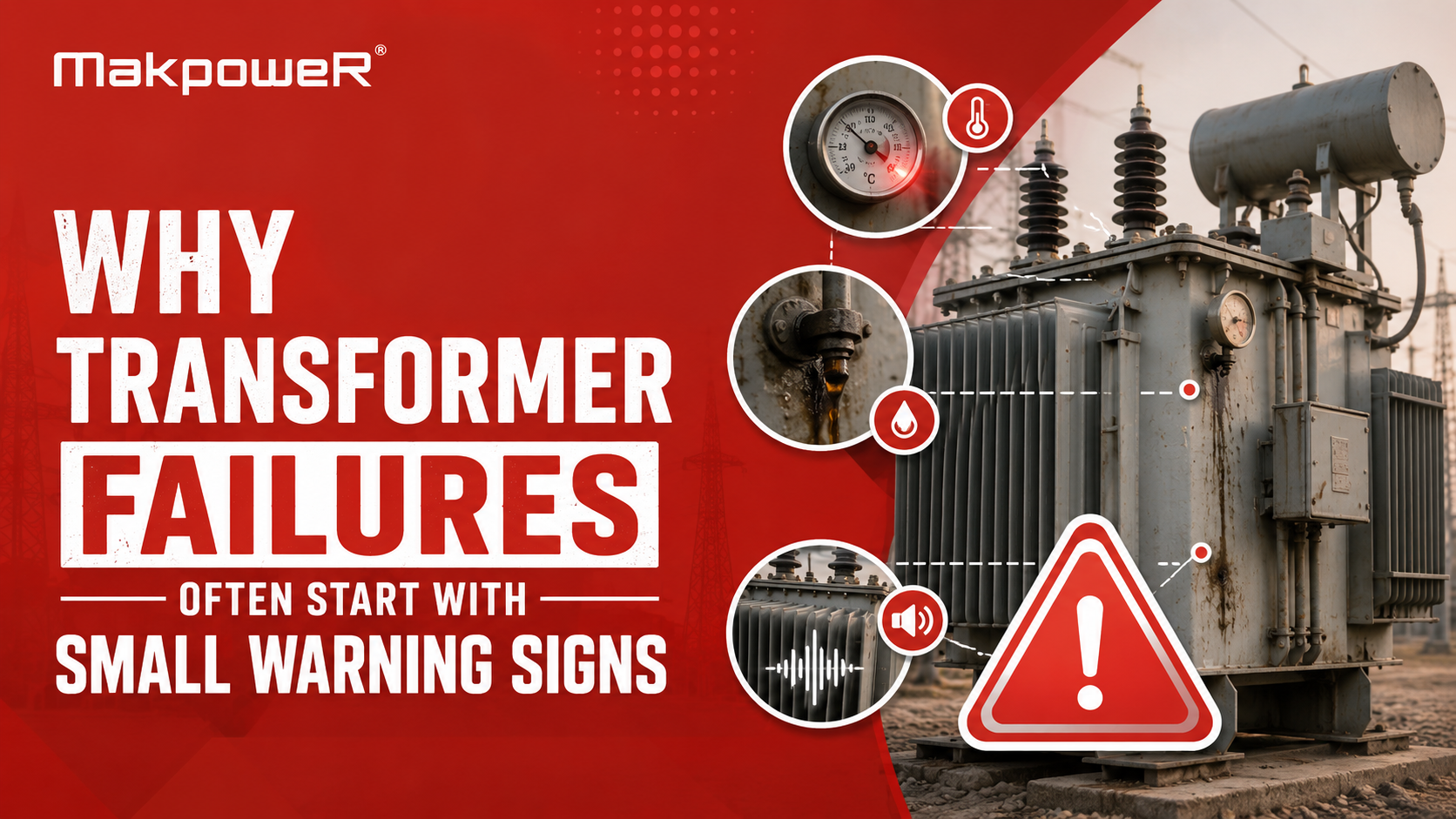
A transformer rarely moves from healthy service to failure in one jump. The change usually begins with a small drift that feels easy to live with.
A temperature runs a little higher, a sound changes under load, or a light stain starts forming near a fitting.
Each sign looks manageable on its own, so the unit keeps working and the pattern keeps growing.
Here’s where those early warnings begin to matter.
The earliest warning signs often come from a physical change already underway inside or around the transformer.
A hotter spot may point to rising resistance at one connection or a cooling path that is no longer performing with the same ease. A light oil trace may point to sealing weakness, pressure change, or a fitting that has started losing its hold. A rougher sound during load variation may suggest looseness, magnetic stress, or a change in the way the unit is carrying duty.
The warning sign may look small, yet it usually belongs to something real.
Early transformer trouble often hides inside familiar plant conditions. Operators may see the unit still carrying load, still holding service, and still looking stable from a distance. That makes the first changes easy to normalize.
A transformer can keep running while one reading drifts, one surface stays warmer, or one part of the unit starts behaving differently from the rest.
The danger often comes from repetition rather than surprise. Once a small shift becomes part of the daily picture, it stops getting treated like a signal and starts getting treated like background.
At makpower, we often find that transformers showing minor recurring abnormalities have already begun developing underlying issues. Recognizing and investigating these early indicators can help prevent more extensive damage and unexpected downtime.
The earliest clues often appear in small, local ways:
> One area starts running warmer than before
> Oil seepage forms near a flange, valve, or fitting
> The transformer sounds rougher during heavier demand
> One reading begins drifting while others stay stable
> Protection response starts feeling more sensitive than usual
None of these signs confirms a major failure on its own.
Taken together, they often show that the unit has already started moving away from its earlier condition.
A small warning sign gives you room to act while the problem is still contained. Once the same sign stays in service for too long, the transformer starts paying for that delay.
A local hot point can spread its effect into insulation or termination stress. A small leak can lead to dirt buildup, moisture entry, or a harder inspection picture. A changed sound can turn into a more visible mechanical or magnetic issue later.
The earlier stage usually gives you the best chance to correct the condition before the transformer starts forcing the matter more clearly.
Transformer failure often begins while the unit is still doing its job. The early stage rarely looks dramatic, which is exactly what makes it easy to misread. In our inspection, repair, refurbishment, and overhaul work, we often see how a small repeated sign turns into a larger condition simply because it stayed in service too long.
If one of your transformers has started showing a change that keeps returning, get in touch with us today and let our team review whether it is still a manageable warning or the start of a deeper problem.
Specialized in Induction Furnace Transformers, Step-Voltage Regulators, and 25 MVA 132kV Substation Class Power Units.
Contact Technical Team